
Why has Sri Lankan's revival been so difficult?

This analysis was made with contributed work and insights from Sanjana Fernando
Download the full analysis as a PDF or continue reading below:
In Brief: With the recent proposal from Transwell, Aeraltus analyses why SriLankan Airlines' revival has been so difficult. Sri Lanka has seen international tourism recover strongly, with arrivals exceeding the 2018 peak only in 2025. Yet SriLankan has lost capacity and market share as demand has recovered.
Its financials show an airline that is operationally healthier than its balance sheet suggests, but its route economics reveal an uneven network, with only a minority of route-aircraft combinations profitable and widebody flying accounting for most of the positive returns. Fernando's public plan, which contains this analysis, proposes cutting the network to 10 profitable widebody destinations and removing lower-yield narrowbody flying.
The financial and operational problems, however, sit within a longer history of changing ownership, management and restructuring. SriLankan has repeatedly changed the structure around the airline without producing a durable commercial settlement. Transwell's proposal takes a different approach, using an escrow structure to link investor capital and eventual ownership to operational performance. The question is whether this can address the structural problems that have kept previous recoveries from lasting.
Sri Lankan Airlines has never lacked an obvious market to serve. Sri Lanka's tourism industry has recovered, India has become an increasingly important source of international visitors, and Colombo sits within a network connecting South Asia with the Gulf, Southeast Asia, Europe and Australia.
Yet the airline has struggled to turn that position into a sustainable business. Its balance sheet has remained deeply negative, its network has lost capacity and market share in important regional markets, and successive attempts to restructure or find new ownership have failed to produce a lasting turnaround.
The latest proposal from Hong Kong-based Transwell brings the question back into focus. Its escrow structure proposes to link investor capital and eventual ownership to operational performance, offering another attempt to change how SriLankan is managed and financed. But the airline's history suggests that its difficulties extend beyond the balance sheet.
Sri Lanka’s International traffic and the India market
Sri Lanka’s international traffic has recovered, but the recovery has not been evenly matched across its network.
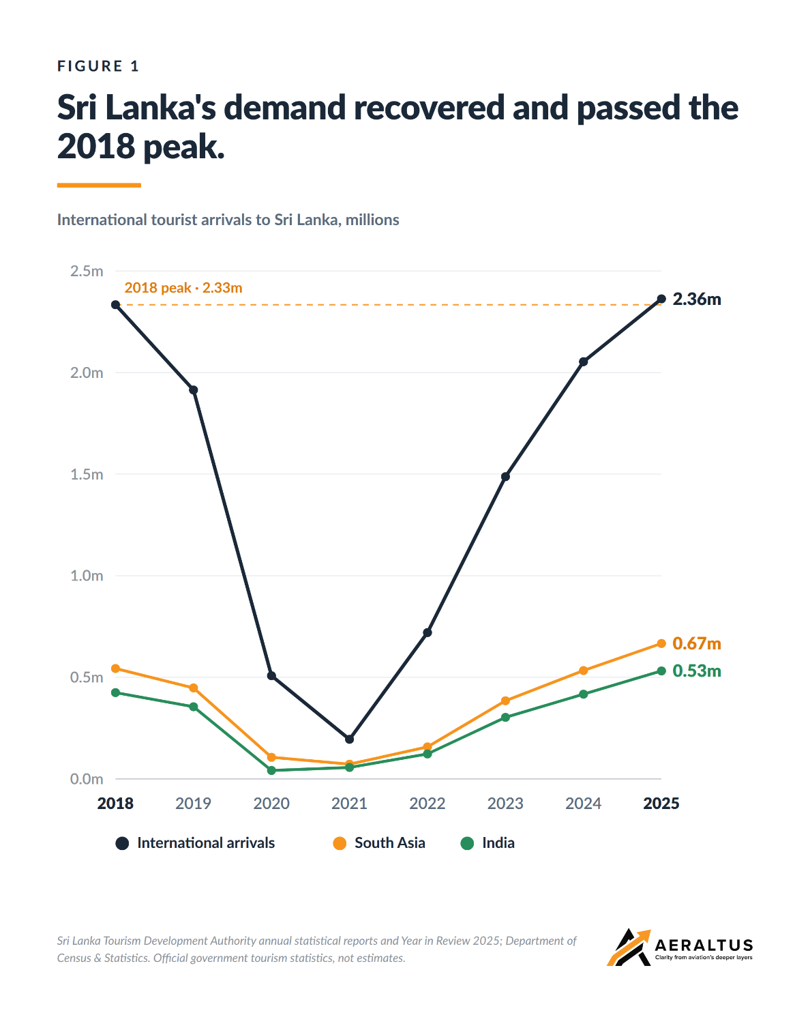
Source: Sri Lanka Tourism Development Authority (SLTDA) annual statistical reports and year-in-review publications, and the Department of Census & Statistics. Official government tourism statistics, not estimates.
Based on data from the Sri Lankan Tourism Development Authority (SLDTA), International tourism has now recovered slightly above its pre-pandemic peak. Sri Lanka recorded 2.36 million international tourist arrivals in 2025, compared with 2.33 million in 2018, after the recovery was interrupted first by the 2019 Easter attacks and then by the pandemic. The recovery is particularly relevant to Sri Lankan airlines because its largest regional source market has recovered strongly as well.
South Asian arrivals exceeded their 2018 level by 23% in 2025, individually for India, Pakistan, Nepal and Bangladesh; only the Maldives had not.
India accounted for nearly 80% of the South Asia arrivals in 2025. It is also one of Sri Lanka’s largest source markets and more than 2.5 times the next-largest market in every year for which the regional series is available. The Sri Lankan Airlines’ investment proposal’s argument for South Asian growth therefore starts with India, but the competitive picture is changing.

In April 2026, IndiGo accounted for 49.51% of Indian arrivals by carrier, up by 7%, a year earlier. Sri Lankan’s share in contrast fell by 5.59%. Air India accounted for a further 11.02%, with the balance made up by other carriers like FitsAir.

There is a route-level shift visible where SriLankan’s passenger traffic between India and Colombo declined in Chennai by 12.9%, while Delhi rose 86% and Mumbai rose 15.8%. This matters because IATA’s 2023 origin-destination data ranks Chennai as Sri Lanka’s largest international city market, with 268,000 departing passengers, 8.9% of all international O&D departures from the country.
SriLankan Airlines' financial position
SriLankan's financial record shows an airline that has periodically recovered its operating business without escaping the financial burden accumulated around it.
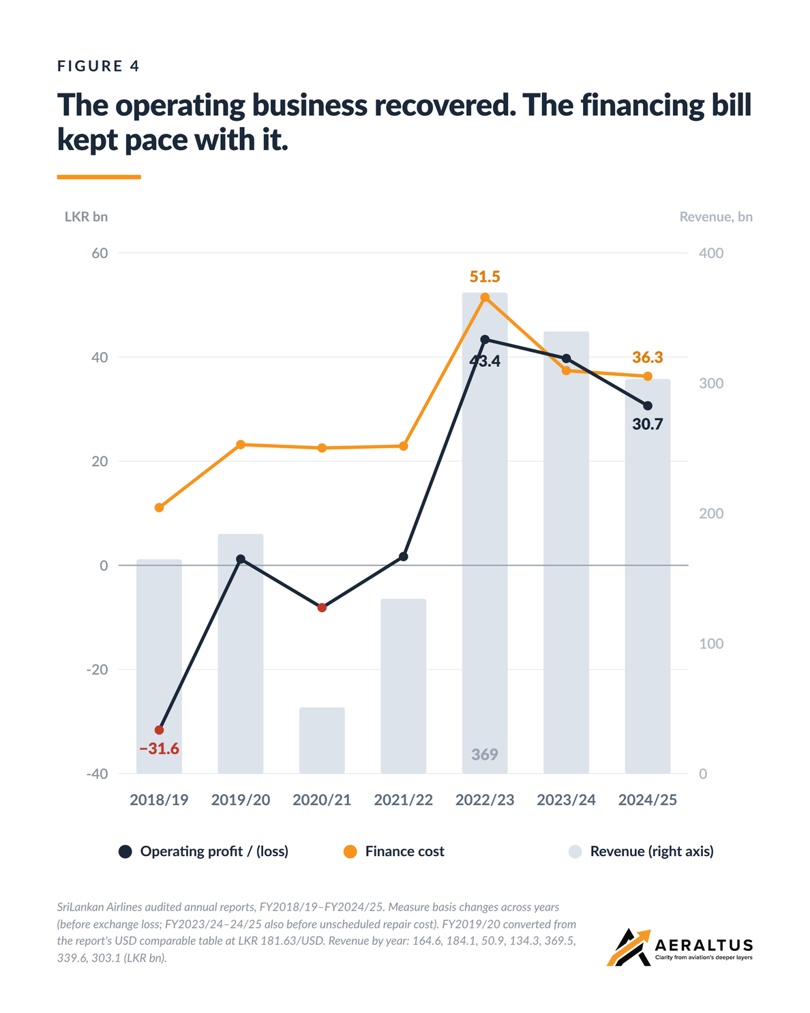
Revenue recovered strongly after the pandemic, reaching a new high in the post-pandemic period before declining over the following two years. The operating result improved sharply after the pandemic, moving from a large loss in FY2018/19 to positive territory from FY2021/22 onward. By FY2022/23, operating profit had reached a level above Rs43 billion. It has since declined, but remained positive through FY2024/25.
Finance costs rose alongside the recovery and remained close to, or above, operating profit. In FY2021/22, a small operating profit was overwhelmed by the foreign-exchange impact of the rupee’s devaluation, producing a much larger net loss.
The more recent reported figures show some improvement after debt restructuring, with EBIT again above interest expense in FY2025/26. The operating business can therefore generate enough to cover much of its financing burden. However, it has not consistently generated enough to rebuild the balance sheet.

The balance sheet shows why. Liabilities rose from roughly Rs250 billion in FY2018/19 to more than Rs700 billion at their peak in FY2022/23. They subsequently declined, but remained more than twice their 2018/19 level in FY2024/25. Negative equity followed the same pattern, reaching almost Rs500 billion before improving to roughly Rs380 billion.
The improvement since the peak has also relied on intervention outside the airline's operating performance. State-bank debt has been restructured, the USD 175 million bond's status has been addressed within the wider restructuring process, and government capital has reduced the reported negative-equity position. The latest reported figures still show hundreds of billions of rupees of liabilities attached to the Group.
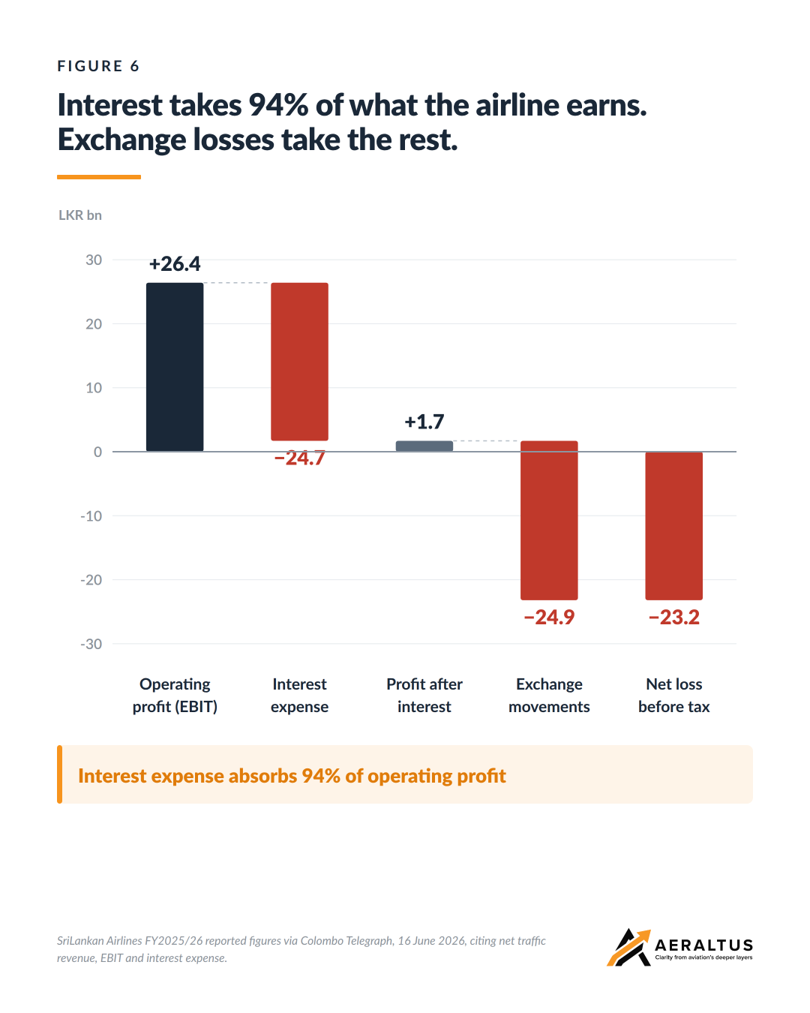
The balance sheet shows how deep the financial hole remains. But the latest reported figures also show that the airline is generating enough operating profit to cover almost all of its interest expense, leaving only Rs1.7 billion before exchange movements. Once those exchange losses are included, the result falls to a Rs23.2 billion loss before tax.
The recovery therefore did not disappear when the airline's financial position remained weak. The airline was generating substantial revenue again while carrying a balance sheet that had deteriorated much further than its operating business.


The traffic data adds another part to the picture. SriLankan has rebuilt a large portion of its post-pandemic traffic, with load factors recovering to around pre-pandemic levels, but its absolute scale remains below FY2018/19. By FY2024/25, passengers, capacity and revenue passenger kilometres were all below their pre-pandemic levels.
Taken together, the four charts point to a more specific problem than an airline simply failing to generate revenue. SriLankan has been able to recover traffic, revenue and operating profitability, but the scale and consistency of that recovery have not been sufficient to overcome the liabilities accumulated over previous years. The result is an airline whose operating business can look substantially healthier than its balance sheet, leaving any new investor with both a functioning commercial operation and a very large financial legacy to absorb or restructure.
What granular Route economics show
The route-level economics show where that operating recovery is being generated, and where it continues to leak value.
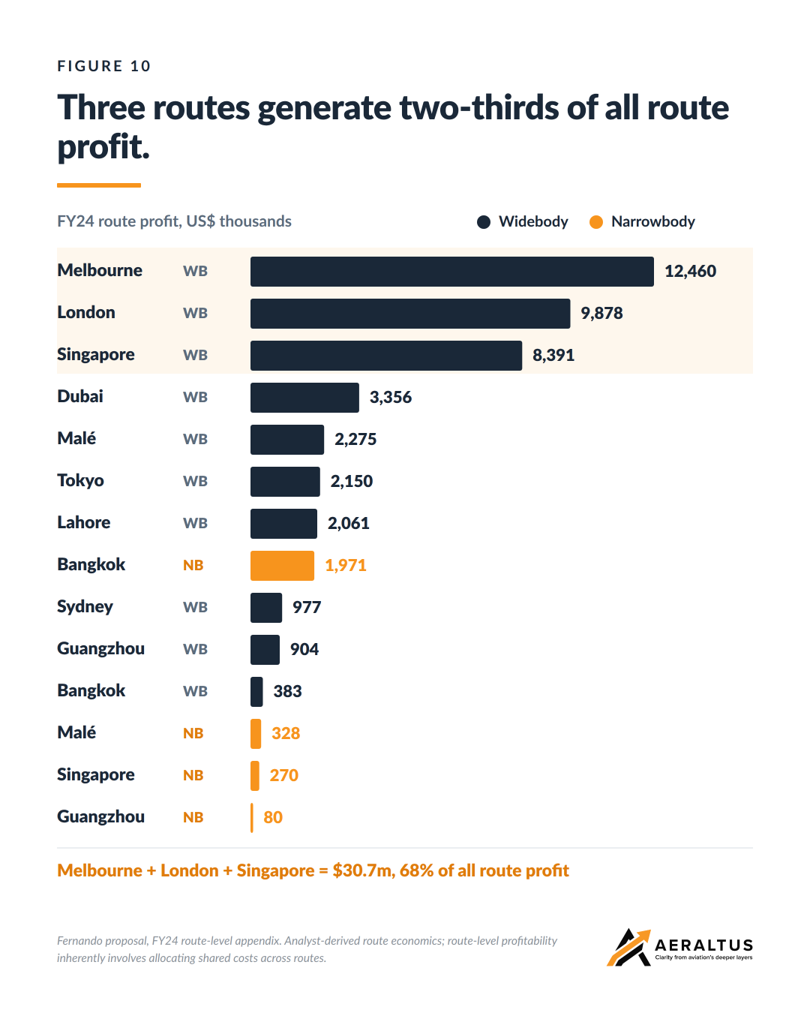
According to Sanjana Fernando's proposal, 14 of 52 route-aircraft combinations were profitable in FY24, generating US$45.5 million, while 38 lost US$72.1 million. The resulting route-level loss was US$26.6 million. These are Fernando's allocations of company-sourced revenue and costs, rather than audited route-level accounts.

The imbalance is concentrated by aircraft type. The 27 widebody combinations generated US$11.8 million of profit, while 25 narrowbody combinations lost US$38.4 million. The widebody operation was therefore profitable at route level, but its returns were insufficient to cover the losses elsewhere in the network.
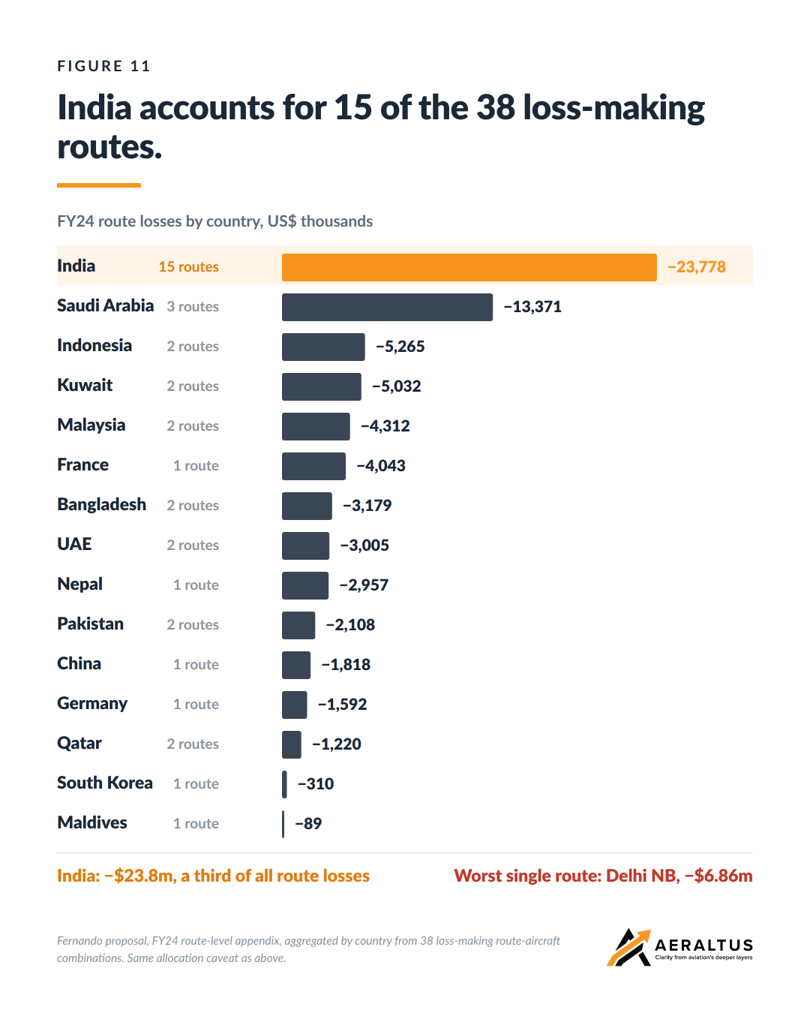
The profitable routes are concentrated in markets including Melbourne, London, Singapore, Dubai, Tokyo and Sydney, while the losses extend across both regional and long-haul flying. India is the largest concentration, appearing in 15 of the 38 loss-making combinations, with Delhi the single largest loss at US$6.86 million.
India illustrates why passenger volumes alone do not explain the losses. All 15 Indian route-aircraft combinations in Fernando's analysis were loss-making, including Chennai narrowbody flying which had an 85% load factor and still lost US$1.64 million, while Delhi lost US$6.86 million at an 83% load factor. Across the Indian network, RASK remained below CASK even on relatively well-filled services.
Fernando's proposed response is therefore a fundamental change to the network. His plan removes narrowbody operations and loss-making routes, leaving 10 widebody destinations from the existing profitable network, none in India, reducing first-year revenue from US$920 million to US$433 million before projecting route-level profits of US$35 million in Year 2 and US$50 million by Year 5.

One important calculation the proposal itself leaves open: Fernando calls for sensitivity analysis of how much revenue on retained services such as London, Melbourne and Sydney comes from passengers originating in India and connecting through Colombo, since removing the narrowbody network also removes the passengers those services contribute to the long-haul operation. A route can contribute value to a network through connecting traffic even when its own city-pair economics are weak, so Fernando’s analysis establishes the losses on the existing network but not how much connecting revenue would disappear with the regional network his plan proposes to cut.
Section 4- timeline and the latest proposal
While the route economics show where that operating recovery is being generated, and where it continues to leak value. The history of the airline shows how difficult it has been to sustain a commercial model around those economics.

Since the end of its Emirates management partnership in 2008, SriLankan has moved through successive attempts to change its ownership, management and financial structure.
The Emirates period shows what changed when commercial management was separated from the state. Emirates took a 40% stake and management control in 1998, modernised the fleet and expanded the network. The airline subsequently returned to state control when the ten-year management agreement ended in 2008, after which its financial performance deteriorated sharply. The later record includes repeated losses, restructuring proposals and attempts to bring in private capital.
The pattern continued after that. Proposals for new holding structures and strategic partnerships were followed by further committees and restructuring plans, while the 2023–24 divestment process attempted to make the airline more attractive to investors by moving a substantial portion of its existing debt onto the state balance sheet. The government ultimately abandoned the sale in July 2024 when no buyer emerged.
The financial restructuring that followed has reduced some of the immediate burden, but it has not changed the underlying position on its own. State-bank debt has been restructured, the USD 175 million bond’s status has been addressed within the wider restructuring process, and the government has continued to provide financial support while a longer-term ownership solution is considered.
The Emirates period stands out because it combined external management control with a substantial commercial rebuilding of the airline; the subsequent periods have largely treated debt, ownership, management and network restructuring as separate exercises.
This does not mean every loss can be attributed to governance. The airline has also been exposed to the Easter attacks, the pandemic, exchange-rate shocks, fuel costs and other events outside management's control. But parliamentary investigations into the 2009–2019 period also identified political interference and weaknesses in commercial decision-making alongside those external shocks.
The recurring issue is therefore broader than whether SriLankan needs another restructuring. It has repeatedly found ways to change the obligations surrounding the airline without establishing a structure that keeps commercial decisions, financial discipline and management control aligned over time.
The Transwell proposal brings that issue back into focus
The proposal submitted by Transwell in August 2026 takes a different approach to the ownership problem. Rather than asking the Treasury to continue funding the airline, it proposes that incoming investors assume responsibility for capital requirements from the outset. The government would initially retain ownership by placing its shares in an escrow trust, with a convertible note governing the eventual transfer of at least 49% of the airline to investors over a ten-year period.
The escrow mechanism attempts to link three things that have often been treated separately in SriLankan’s restructuring history — capital, management performance and eventual ownership — by tying the transfer of ownership and release of investment capital to performance rather than making the ownership change immediate. The proposal sets operational milestones around on-time performance, CASK reduction, aircraft utilisation and aircraft-on-ground rates, followed later by targets for Colombo’s connecting traffic.
The structure is still a proposal under government review, rather than an executed transaction. And its significance for the airline's long-term economics will depend on whether the proposed operating model can generate the returns required to support the capital being committed. The latest proposal therefore represents another attempt to solve the problem that has followed SriLankan since the end of the Emirates partnership, but with the investor's capital and ownership made conditional on operational performance.
Transwell's proposal tries to make capital access, operating performance and ownership conditional on one another. Whether that can work depends on the operating model underneath it. The route analysis has already shown that SriLankan has a profitable long-haul core alongside a much larger pool of loss-making flights. The next issue is whether the institutional structure around the airline has allowed that network to be developed consistently enough to produce sustainable returns.
What Thai Airways did differently
Thai Airways is a useful comparison because it faced a similar combination of legacy debt, an underperforming national carrier and a hub network that still had commercial value. What changed was not simply the airline's willingness to restructure, but the legal mechanism through which the restructuring happened.
Thai entered court-supervised rehabilitation in May 2020, with its plan approved by Thailand's Central Bankruptcy Court in June 2021. The process brought creditors, debt, contracts, management authority and the airline's operating plan into one binding framework, allowing Thai to restructure its obligations and reject uneconomic aircraft and other contracts as part of the rehabilitation rather than negotiating each problem separately.
The financial reset was followed by an operating reset. Thai retained Bangkok as a major hub, integrated Thai Smile's 20 A320s into the mainline fleet and began replacing older short- and medium-haul capacity with A321neos. By the time it exited rehabilitation in June 2025, it had reduced its restructured debt substantially while retaining a broad international network.
This is where the comparison with SriLankan becomes useful. Fernando's FY24 analysis shows US$11.8 million of widebody route profits against US$38.4 million of narrowbody losses, leading his proposal to remove the narrowbody network altogether. Thai took a different approach by using its rehabilitation process to restructure the obligations around its network while retaining and integrating regional capacity.
The difference is that Thai had a legal process that allowed the financial, contractual and operational restructuring to happen together, while SriLankan has dealt with these problems through separate debt restructurings, government support and ownership proposals that do not by themselves bind creditors, contracts and commercial management the way Thai’s court-supervised process did, which is what has made SriLankan’s fixes easier to reverse.
This also explains why Transwell is relevant to the comparison. Its escrow proposal tries to connect capital, operational performance and eventual ownership, with investor funding released against milestones rather than making the ownership transfer immediate. Its targets also assume that narrowbody aircraft can remain part of the model, with utilisation rising to at least 12 hours a day and connecting traffic growing by 15% in the third year.
That puts Transwell's proposal in direct contrast with Fernando's network plan. One proposes to remove the regional network; the other proposes to make it more productive and use it to grow the Colombo hub. Both are attempting to solve the same underlying economics from different directions.
The remaining difference is institutional, where in Transwell's published KPIs address costs, utilisation, reliability, connectivity and workforce productivity, but do not publicly establish how commercial management would be protected from the political or governance pressures identified elsewhere in SriLankan's history. The proposal may therefore change how the airline is operated and financed without yet demonstrating how the conditions that made previous recoveries reversible would be permanently changed.
Transwell is the latest attempt to create that structure, but whether its escrow and performance mechanism achieves it is still an open part of the proposal.
What would prove this diagnosis wrong
The diagnosis is that SriLankan's problem extends beyond demand and the balance sheet, into the economics of its network and the structure through which the airline has been managed and restructured. It would be weakened if the regional network generates substantially more connecting revenue for long-haul services than Fernando's route analysis captures, or if SriLankan's latest restructuring has already created durable protections for commercial management.
Transwell provides the clearest test. If its model can retain narrowbody flying, improve utilisation and connecting traffic, achieve sustained profitability and reduce reliance on state support, the case for removing the regional network becomes weaker. If those improvements cannot be sustained despite meeting the operating targets, the problem would point beyond utilisation and route selection.
Thai provides a second test. If SriLankan can achieve a comparable reset of its debt, contracts, capital and commercial management within its existing legal and ownership structure, then the institutional difference between the two airlines is less important than this analysis suggests.
The diagnosis can therefore be disproved by a durable commercial recovery that fixes the network economics and balance-sheet burden while also preventing the management and ownership problems of previous restructurings from recurring.
Closing Thoughts
The history suggests that the problem sits beyond the network itself. SriLankan has repeatedly changed ownership, management and financial arrangements without establishing a structure that keeps commercial decisions, capital and the network aligned over time. Thai Airways shows what a more comprehensive reset can look like, where the financial and contractual obligations of the airline were restructured alongside its operating model under a binding rehabilitation process.
Transwell's proposal is another attempt to create a durable structure around SriLankan, linking investor capital and eventual ownership to operational performance. Its success will depend not only on whether the airline can improve utilisation, costs and connectivity, but whether the structure can prevent the commercial model from becoming reversible again. SriLankan has had the ingredients for a viable airline. What it has repeatedly lacked is a structure capable of turning those ingredients into a sustainable one.
Author's Note
This analysis is based on public information including Sri Lanka's Parliamentary Series No. 168 committee report on SriLankan Airlines, Auditor General of Sri Lanka audit reports, SriLankan Airlines' audited annual reports and Ministry of Finance filings, Thai Airways International's financial statements and Central Bankruptcy Court rehabilitation records, Sri Lanka Tourism Development Authority and Department of Census & Statistics arrival data, Sanjana Fernando's proprietary route-economics business plan for SriLankan Airlines (STF Corporate Advisory, March 2025), used with permission, aviation trade press, and Aeraltus prior analysis. Where a figure appears in more than one public source with materially different values, such as SriLankan's reported negative-equity position across its FY2024/25 annual report and the mid-2026 restructuring committee's in-year disclosures, the more recent and more widely corroborated figure is used, and the discrepancy is noted in the piece itself rather than silently resolved.
Aeraltus does not hold a position in SriLankan Airlines, Transwell Corporation Limited, Thai Airways International, Emirates, or any entity named in this analysis.
About Aeraltus
Aeraltus is an aviation intelligence platform that produces structural and in-depth analysis and intelligence with a focus on emerging markets across Asia and Africa. Our mission is to open, inform and connect across the siloes that shape and move the aviation industry.
Beyond our published work, Aeraltus delivers custom analysis and intelligence for institutional investors, strategy teams, infrastructure advisors, OEM analysts, lessors and corporate development groups. Engagements range from single deep dives to recurring and retained relationships covering an entire portfolio or sector thesis. Contact info@aeraltus.com to discuss confidential briefings, commissioned reports or recurring engagements.
Aeraltus also welcomes topic suggestions and feedback, contributions from industry experts, and enquiries from companies interested in paid features. Reach out at the same email address to suggest a topic, contribute to a deep piece or discuss a feature.
Sources
For a full list of sources, see the PDF attached above.


