
Why is Indonesia merging its state carriers now?

Read the full analysis as a PDF or continue reading below:
In Brief: Indonesia is consolidating Garuda Indonesia, Citilink and Pelita Air under a single state-owned airline holding company. Indonesia's sovereign wealth fund, Danantara Indonesia, confirmed the structure in July 2026, after years of restructuring and rapid change in the domestic market. Garuda has rebuilt part of its market share and repaired its balance sheet, but its passenger volumes and operating profitability remain well below pre-pandemic levels. Citilink holds almost exactly the domestic share it held in 2019 while carrying a fifth fewer passengers. Pelita has grown from a contingency carrier into a 4.42% domestic operator in four years. Danantara sees duplicated routes, aircraft, procurement and corporate functions as an opportunity to create efficiencies, using the 2021 merger of Indonesia's four state port operators into Pelindo as its precedent. The consolidation has a clear industrial logic but the structure is yet to be finalised. Additionally, Garuda's constraints and the aviation market complicate whether this consolidation can match the precedent of other state enterprise consolidations. Its outcome depends on whether Danantara can turn common ownership into better fleet utilisation, route economics and cost control.
Cover Image Credit: Tempo.co
Indonesia is moving toward a single state-owned airline holding company, with Garuda Indonesia expected to sit at the centre and Citilink and Pelita Air underneath it. Danantara confirmed the structure in July 2026, after years of discussion that began during Garuda's restructuring. The plan includes integrating booking and loyalty systems and coordinating aircraft and routes across the three airlines.
The timing sits within a much larger restructuring of Indonesia's state-owned enterprises. President Prabowo Subianto has set out a plan to reduce an SOE ecosystem of roughly 1,000 companies to around 200, while Danantara is using the 2021 consolidation of four state port operators into Pelindo as a model for reducing duplication across state assets.
Danantara has presented the consolidation through the language of efficiency, productivity and reduced market cannibalisation. The airlines show a more complicated picture. Garuda has emerged from a major restructuring with a smaller fleet, a repaired balance sheet and a domestic market share below its 2019 position. Citilink holds the share it held in 2019 but carries a fifth fewer passengers. Pelita has grown from a contingency airline prepared during the Garuda crisis into a carrier with 4.42% of Indonesia's domestic market.
The overlap is now large enough to be visible in the operating data. Garuda, Citilink and Pelita together accounted for 32.39% of scheduled domestic passengers in 2025. Danantara has itself identified Jakarta-Surabaya as a market where all three operate separately, alongside a broader opportunity to share booking, loyalty infrastructure and aircraft capacity.
The consolidation therefore brings together three very different pieces of the state aviation system: a restructured flag carrier carrying the weight of its old cost base, a scaled low-cost subsidiary that has retained its domestic position, and a newer airline that the state built up while Garuda was being rebuilt. The question is whether putting them under one holding company will remove the duplication between them or simply place three different operating models under the same roof.
How Indonesia's passenger market and competitive structure has evolved
Indonesia's domestic aviation market remains below its pre-pandemic size. Scheduled domestic airlines carried 79.5 million passengers in 2019; by 2025, that had recovered to 63.6 million, leaving the market around one-fifth smaller.

The contraction has reshaped who captures the remaining traffic. Garuda Indonesia's domestic passenger numbers fell from 15.5 million in 2019 to 4.7 million in 2022, while its market share dropped from 19.56% to 8.24%. By 2025 its share had recovered to 13.26%, but passenger numbers had reached only 8.4 million, just over half their 2019 level. Garuda has recovered more of its market position than its underlying traffic volume.
Citilink's position held while its traffic fell. Its domestic share was 14.93% in 2019 and 14.71% in 2025, slightly ahead of Garuda. Its passenger volume fell from 11.9 million to 9.4 million over the same period, a decline of 21%. Citilink tracked the market down rather than recovering within it.
The space created by the contraction has also been filled by newer competitors. Super Air Jet went from 1.19% of the domestic market in 2021 to 17.18% in 2025. Pelita Air went from no scheduled domestic traffic to 4.42%, carrying 2.8 million passengers in 2025. The post-pandemic market has redistributed traffic across a wider group of airlines. The pre-pandemic hierarchy has not returned.

The international market has recovered further. Indonesia's carriers and the foreign airlines serving it carried 39.4 million international passengers in 2025 against 37.3 million in 2019. Garuda's international passengers moved the opposite way, falling from 4.34 million to 3.14 million over the same period.
Foreign carriers took most of that growth. Singapore Airlines carried 3.06 million international passengers in 2025, almost matching Garuda's 3.14 million, while Indonesia AirAsia, AirAsia Berhad, Malindo and Jetstar all hold significant positions. Garuda's share of the international market fell from 12.98% in 2018 to 5.18% in 2022, and has recovered only to 7.96%.
Indonesia's international market has grown beyond its 2019 level while Garuda's international traffic remains well below it. The domestic market took a different path. Passenger volumes remain below 2019, and the competitive structure has shifted toward newer and lower-cost operators. Garuda and its subsidiaries now compete in a market that recovered unevenly in volume and changed shape in composition.
How Garuda's restructuring reduced its debt burden without resolving its cost base
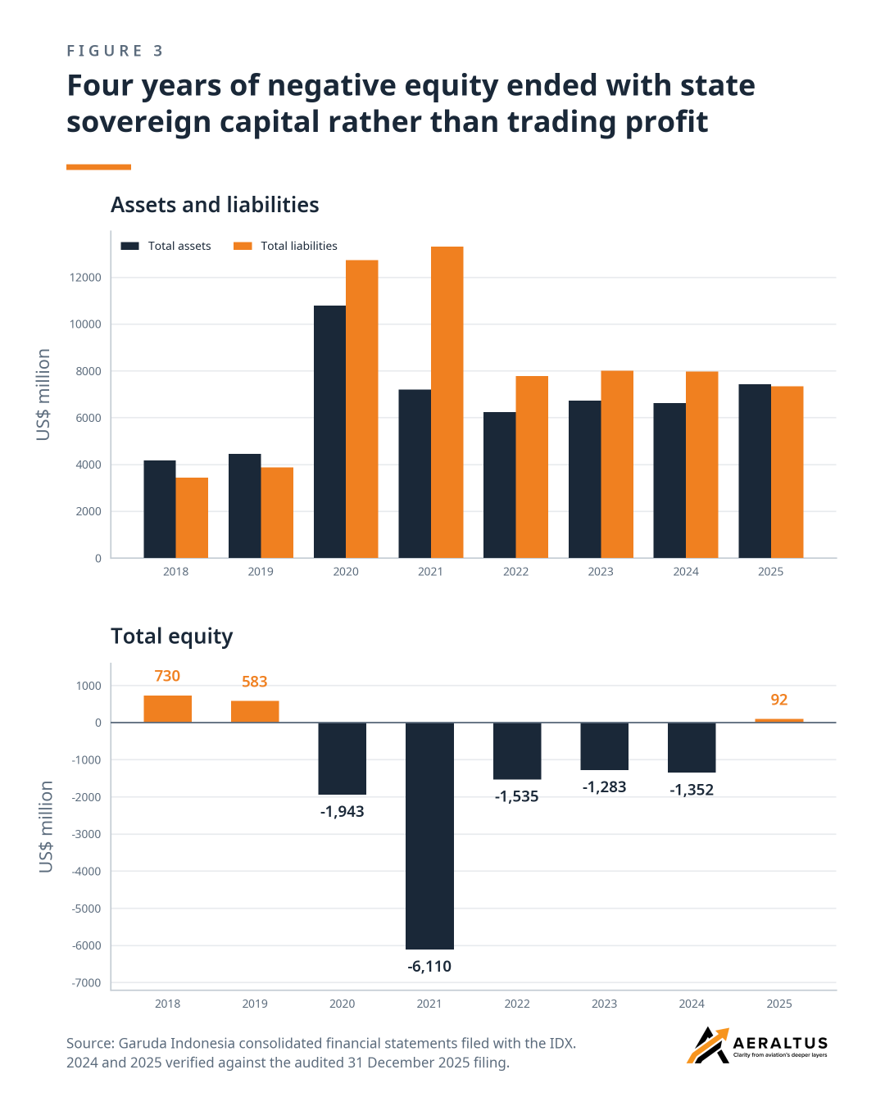
Garuda Indonesia entered its 2021 restructuring with a balance sheet that had been overwhelmed. Total liabilities reached $13.3 billion against $7.2 billion of assets, leaving negative equity of $6.1 billion. The PKPU process, which concluded in 2022, brought liabilities down to $7.8 billion and cut total debt roughly in half, from $8.3 billion in 2021 to $4.2 billion. Equity improved sharply as creditors accepted haircuts, but it remained negative at $1.5 billion.
Lease liabilities made up roughly 59% of Garuda's total debt in both 2025 and the first quarter of 2026, at $2.33 billion and $2.28 billion. Garuda needs the aircraft behind those leases to operate, which narrows the room for any balance-sheet fix that refinances or retires financial debt.

The restructuring also imposed a much smaller operating platform. Garuda entered the pandemic with 142 aircraft and planned to emerge with 66. By late 2023, it operated 58 aircraft, concentrating capacity on profitable routes. On that smaller platform, Garuda delivered its strongest post-restructuring year in 2023: $2.94 billion in revenue, $309.9 million in operating profit, and a net profit of $252 million. Even in that best year,
operating profit represented only a 10.6% margin on revenue.

That recovery lasted one year. Garuda held operating profit almost unchanged at $308.6 million in 2024, then watched it fall to $113.9 million in 2025, a 63% decline that cut the operating margin to 3.5%. Revenue fell from $3.42 billion to $3.22 billion. Finance costs moved the opposite way throughout, rising from $412.7 million in 2022 to $456.8 million in 2023, $479.9 million in 2024 and $525.8 million in 2025. By 2025 finance costs ran more than four times operating profit.
The 2022 result shows why the headline number misleads. Garuda reported a net profit of $3.74 billion on revenue of $2.10 billion. Profit exceeded revenue because roughly $4.2 billion of it came from writing down debt in the PKPU process, not from carrying passengers. Operating profit that year was $104.2 million. The restructuring delivered an accounting gain around forty times the size of the operating result it was meant to make possible, and that gap is the argument of this section. The balance sheet moved. The operating business did not.

Maintenance has added another pressure. Indonesia's 37.9% import duty on aircraft spare parts helped push maintenance from 13% of Garuda's operating expenses in the first quarter of 2023 to 21.7% in the first quarter of 2025. Garuda's accounts show its aircraft return and maintenance provision more than doubling over the same window, from $92 million in 2022 to $194.5 million in 2025. The provision covers returning leased aircraft in contractual condition, and it has kept growing well after the fleet cuts that created it.
The balance sheet finally turned positive in 2025, with equity reaching $91.9 million. That turn came after Danantara injected roughly $1.43 billion into Garuda in December 2025, a sum more than fifteen times the equity position it produced. Danantara's capital repaired the reported balance sheet after three years of negative equity, but it did not produce an operating recovery.
Garuda's restructuring solved a large part of the liability problem while leaving the operating cost structure largely intact. The airline delivered one strong operating year after PKPU, then watched operating profit fall sharply while finance costs kept climbing. By the time Danantara brought Pelita into the consolidation discussion, Garuda had already needed a second major balance-sheet intervention to remain financially viable. The merger arrives alongside a restructuring that has reduced Garuda's debt stock but has yet to build a self-sustaining cost base.
How Pelita Air growth overlapped and absorbed traffic that Garuda lost
Pelita Air did not begin as a passenger airline. Pertamina established it in 1963 as Pertamina Air Service to support oil and gas exploration, moving personnel and equipment to remote drilling sites. It became PT Pelita Air Service in 1970. Its only earlier attempt at scheduled commercial flying came under Pelita AirVenture between 2000 and 2005, after which the company returned to charter and Pertamina-support operations.
That history gave Pelita a very different starting position from Garuda when the government began rebuilding it as a scheduled carrier. Pelita entered the pandemic without a large scheduled passenger network to defend. Its business remained centred on charter operations and Pertamina-related flying, so the collapse in scheduled passenger demand did not hit an established passenger franchise the way it hit Garuda.
In 2021, Pelita's dormant aviation platform acquired a new strategic role. As Garuda entered its restructuring, the Ministry of BUMN prepared Pelita as a reserve national carrier in case Garuda failed. Pelita could therefore move into scheduled aviation without first dismantling the legacy passenger network and liabilities that Garuda was trying to restructure.

Pelita's domestic capacity grew twelvefold between 2022 and 2025, from 281 million available seat-kilometres to 3.53 billion. Garuda's domestic capacity in 2024, the last year DGCA reports consistently, was 21.5 billion. Pelita has built roughly a sixth of Garuda's domestic capacity from nothing in three years.
The scale-up was rapid. Pelita carried only 167,188 domestic passengers in its first year of scheduled operations in 2022. That rose to 1.32 million in 2023, 2.68 million in 2024, and 2.81 million in 2025, nearly a seventeen-fold increase in three years. Its domestic market share rose from 0.30% in 2022 to 2.01% in 2023, 4.07% in 2024, and 4.42% in 2025.
Pelita moved quickly from building a network to filling it. Its load factor rose from 52.96% in 2022 to 78.70% in 2023 and 79.62% in 2024, then eased to 76.57% in 2025, within two points of Garuda's own 81.20%. Departures grew more than elevenfold, from 1,796 to over 20,000. By 2025 Pelita was a meaningful domestic operator inside a market where Garuda carried 13.26% of passengers.
The growth also coincided with a shortage of aircraft across Indonesian aviation. Indonesian reporting cited industry figures putting the active scheduled domestic fleet at 393 aircraft, with another 173 undergoing maintenance, against an estimated requirement of around 700. Pelita therefore expanded into a market where aircraft availability itself constrained capacity. Its growth gave the state another source of domestic lift at a time when Garuda had deliberately emerged from restructuring with a much smaller fleet.
Pelita's position inside the Pertamina group adds another layer to its economics. Pertamina Patra Niaga supplied 72 airports and held 99.97% of Indonesia's avtur market, according to KPPU's September 2024 preliminary findings. KPPU also identified preliminary evidence of monopoly and market-control violations, including an allegation that fuel sales were restricted to affiliated companies. Indonesian media reported avtur prices as the highest in Southeast Asia.
Fuel matters disproportionately because Pelita's CEO, Dendy Kurniawan, put avtur at roughly 40% of an airline's operating costs. Garuda also buys its fuel from Pertamina Patra Niaga, and the November 2025 Danantara capital plan allocated 12% of its Rp29.8 trillion injection specifically to settle Garuda's outstanding avtur debt to Pertamina. The relationship runs through both airlines' operating economics, while the fuel supplier sits inside the same wider state-owned corporate system as Pelita.
Pelita now occupies an odd position in Indonesian aviation. The government developed it as a contingency for a failing Garuda, then built it into a growing scheduled carrier while Garuda remained a major but financially constrained competitor. By 2025 the two state-linked airlines together carried 17.68% of Indonesia's scheduled domestic passengers, Pelita 4.42% and Garuda 13.26%. Combined they still trail Lion Air's 23.28% by 5.6 points.
Pelita is no longer a backup airline. It is a sizeable operating asset alongside Garuda, with its own aircraft, routes, passengers and commercial infrastructure, and both airlines sit inside the same Indonesian capacity constraints and the same Pertamina-controlled fuel environment. The question facing the state is how much value remains in running two state-controlled airline platforms that have grown into the same domestic market.
What are the constraints arising from the consolidation and why it may not be like the state's other consolidation attempts
The Garuda-Pelita consolidation sits inside a broader effort to cut the number of state-owned companies and place them under sectoral holding structures. President Prabowo Subianto said the consolidation of 250 SOEs had reduced overhead costs by Rp50 trillion, roughly $3 billion, by July 2026, citing savings from duplicated directors and commissioners, office space and utilities. Danantara has set a broader objective of reducing an ecosystem of roughly 1,000 state companies to between 200 and 240, with one holding company for each major sector. The airline consolidation developed alongside that mandate. It did not start as a standalone response to Garuda's financial problems.
The plan moved from contingency to consolidation over five years. BUMN Deputy Minister Kartika Wirjoatmodjo described Pelita in late 2021 as a sekoci cadangan, a reserve lifeboat, if Garuda's Rp70 trillion restructuring failed. The BUMN Ministry first proposed a merger in 2023. Danantara framed it around asset and spare-parts efficiency in September 2025, then around duplicated routes and shared booking and loyalty systems in February 2026.

The timetable has stretched. Danantara COO Dony Oskaria targeted the first quarter of 2026 for Garuda to become the holding company, and Rohan Hafas described completion within the first half of the year. By July, Dony was still describing the structure as an intention. In August, Garuda's corporate secretary was still telling investors that the legal form, valuation and transaction structure remained under review.
The movement in the deadline reflects a real constraint. Danantara has settled the direction of travel. It has not settled the corporate mechanics. Putting three airlines under one holding company does not by itself combine their assets, liabilities, employees, aircraft leases, contracts or operating certificates.
Danantara has a domestic precedent. Indonesia consolidated its four state port operators, Pelindo I through IV, into a single entity in 2021, and officials have cited roughly a 50% reduction in operating costs. Danantara has used the port merger as its model for aviation. The port operators had overlapping corporate functions, and Indonesia removed duplicated management and support layers while the underlying operating businesses stayed distinct.
The airline case holds a similar opportunity at the corporate level, and a harder problem below it. Garuda, Citilink and Pelita carry different brands, fleets, customer propositions, route structures and operating histories. Their aircraft sit under separate leases and maintenance obligations, and Garuda still carries the legacy cost base described in the previous section. A holding company can centralise procurement, finance, technology and loyalty without merging the airlines themselves. How far Danantara intends to go beyond that remains unresolved.
The public rationale has accumulated without converging into one operating plan. Rosan Roeslani has emphasised asset, flight-hour and spare-parts efficiency. Rohan Hafas has focused on duplicated routes, shared booking and loyalty infrastructure, and revenue from existing capacity. Dony Oskaria has framed the holding company around competitive strength and market control. These objectives can coexist, but they imply different tests for whether consolidation creates value.
The market data make the route-overlap rationale concrete. Garuda and Pelita hold 13.26% and 4.42% of the domestic passenger market, and Citilink another 14.71%. Rohan Hafas has named Jakarta-Surabaya as a route where all three operate separately. The consolidation case has an identifiable overlap to address alongside the corporate efficiencies, and it also has to allocate aircraft, routes, employees, leases and capital between a financially repaired but still expensive Garuda and a younger Pelita carrying none of that legacy.
That leaves the consolidation with a clear structural rationale and a much less settled implementation model. Danantara has a proven SOE-consolidation template, a quantified overhead-saving objective and identifiable duplication among the airlines. The unresolved issue is whether the airline group can reproduce the efficiencies of Pelindo while preserving the operating economics of three very different carriers.
What consolidation could actually change
Malaysia Aviation Group offers the closest international comparison, and the honest version of it is a caution, not a template. Khazanah Nasional launched its Malaysia Airlines recovery plan in 2014 targeting a return to profitability within three years. The airline didn't turn a genuine profit until 2023, nine years later, after three different CEOs and repeated rounds of additional capital beyond the original plan. What made that eventual recovery possible was a shareholder willing to keep funding losses for the better part of a decade without a fixed deadline. Danantara doesn't have that kind of runway. It is working against a dated political mandate, not an open-ended one.
The strongest case for consolidation sits in the layer between the airlines. Shared systems, coordinated capacity, and common infrastructure carry more weight than which single company owns the three brands.
A combined group could reduce duplicated corporate functions, coordinate fleet and maintenance planning, consolidate procurement and technology, and allocate aircraft more efficiently across overlapping networks. Rohan Hafas has also pointed to a common booking system, an integrated loyalty programme, and the ability to shift seats between airlines as ways to generate revenue from existing capacity.
The route overlap provides a more immediate opportunity. Garuda, Citilink, and Pelita all operate routes such as Jakarta-Surabaya, allowing the group to adjust frequency and aircraft deployment across one shared network, where three separate state carriers currently compete for the same passengers.
The larger opportunity is coordination of capacity. Garuda has emerged from restructuring with a smaller fleet and a heavy legacy cost base. Pelita has built a new domestic network and reached 4.42% market share. Bringing the two into one group could let the state use Pelita's growth alongside Garuda's established network. Right now, the two continue building overlapping capacity independently.
Whether the group can challenge Lion Air is the commercial test. Lion Air carried 23.28% of domestic passengers in 2025. Garuda, Citilink and Pelita together carried 32.39%. On paper the merged group leads by nine points. The three brands already fly the same routes against each other, so a share that reads as leadership on a spreadsheet behaves as fragmentation in the market. Lion Air competes as one network with one cost base and one schedule, and consolidation is the only route by which 32.39% becomes a position rather than an aggregate. It also raises a competition question the government has not addressed publicly. A single state group holding a third of domestic passengers changes the structure of the market every other carrier operates in.
But consolidation alone does not remove Garuda's underlying financial obligations or make an uneconomic route profitable. The value depends on whether Danantara can turn common ownership into actual changes in fleet utilisation, maintenance, procurement, and network deployment.
What would prove this wrong, and closing
First, whether Pelita's aircraft and routes get reassigned following a visible, complementary logic once the holding company is operational, the way Firefly's routes were reallocated inside Malaysia Aviation Group, or whether they are simply absorbed with no schedule change, closer to how MASwings was administratively transferred regardless of underlying route economics.
Second, whether Jakarta-Surabaya specifically, Danantara's own named example, stops being flown by all three brands separately. This is directly checkable against published schedules once any restructuring takes effect.
Third, whether the holding company's legal structure actually gets finalized at all, given it has already slipped past at least two announced deadlines (Q1 2026 and 'this semester'/H1 2026) with the legal form still described as under review by GIAA's own Corporate Secretary as of mid-August 202612.
Fourth, whether Garuda's underlying cost structure, specifically the tariff-inflated maintenance costs and the aircraft-return provision, actually improves following the merger, or whether the holding company changes nothing about the cost base that broke the 2023 recovery in the first place. This is checkable against Garuda's own future audited financial statements.
Closing thoughts
Garuda and Pelita now occupy positions created by the same disruption, but they reached them through very different paths. Garuda has rebuilt its balance sheet and part of its domestic market position after a severe restructuring, while its traffic and profitability remain below the levels that supported its pre-pandemic network. Pelita entered scheduled aviation during that restructuring and built a 4.42% domestic market share in four years. The two airlines now operate alongside Citilink across a domestic market that remains smaller than in 2019.
That gives Danantara a credible basis for consolidation. The state already has overlapping networks, duplicated corporate infrastructure and a growing Pelita operation sitting alongside Garuda's established network. Danantara has also demonstrated through Pelindo that it can use an SOE holding structure to remove duplicated overhead while keeping operating businesses within a common group. The proposed airline structure can therefore address real inefficiencies in the existing system.
The financial history makes the limits of that argument equally clear. Garuda's restructuring removed much of its old debt burden, yet finance costs continued to rise and operating profit weakened sharply after 2023. The 2025 recapitalization repaired its equity position, while Pelita brought a newer operating platform into the group. Consolidation can improve how those assets are deployed, but the benefits will depend on actual changes to fleet utilisation, route allocation, procurement, maintenance and the cost base.
The merger therefore represents a significant change in the organisation of Indonesia's state-owned aviation sector. Its success will depend on whether Danantara uses consolidation to redesign the operating system around the airlines, rather than simply placing three existing businesses under one corporate structure.
Author's Note
This analysis is based on public information including Indonesia's Directorate General of Civil Aviation (DGCA) Statistik Angkutan Udara yearbooks (2019–2025 editions), PT Garuda Indonesia's audited consolidated financial statements filed with the Indonesia Stock Exchange, Indonesia's Komisi Pengawas Persaingan Usaha (KPPU) public findings on avtur supply, Khazanah Nasional Berhad's own press releases and quarterly progress updates on the Malaysia Airlines Recovery Plan, Malaysia Aviation Group's corporate disclosures, Indonesian and English-language aviation and business press, and Aeraltus prior analysis.
Where a figure appears in more than one public source with materially different values, such as the Rp23.7 trillion and Rp29.8 trillion figures separately reported for Danantara's December 2025 capital injection into Garuda, the more recent and more widely corroborated figure is used, and the discrepancy is noted in the piece itself rather than silently resolved.
Aeraltus does not hold a position in Garuda Indonesia, Citilink, Pelita Air, Pertamina, Danantara, Malaysia Aviation Group, or any entity named in this analysis.
About Aeraltus
Aeraltus is an aviation intelligence platform that produces structural and in-depth analysis and intelligence with a focus on emerging markets across Asia and Africa. Our mission is to open, inform and connect across the siloes that shape and move the aviation industry. Visit aeraltus.com to know more.
Beyond our published work, Aeraltus delivers custom analysis and intelligence for institutional investors, strategy teams, infrastructure advisors, OEM analysts, lessors and corporate development groups. Engagements range from single deep dives to recurring and retained relationships covering an entire portfolio or sector thesis. Contact info@aeraltus.com to discuss confidential briefings, commissioned reports or recurring engagements.
Aeraltus also welcomes topic suggestions and feedback, contributions from industry experts, and enquiries from companies interested in paid features. Reach out at the same email address to suggest a topic, contribute to a deep piece or discuss a feature.
For a full list of sources read the PDF above
Sources


